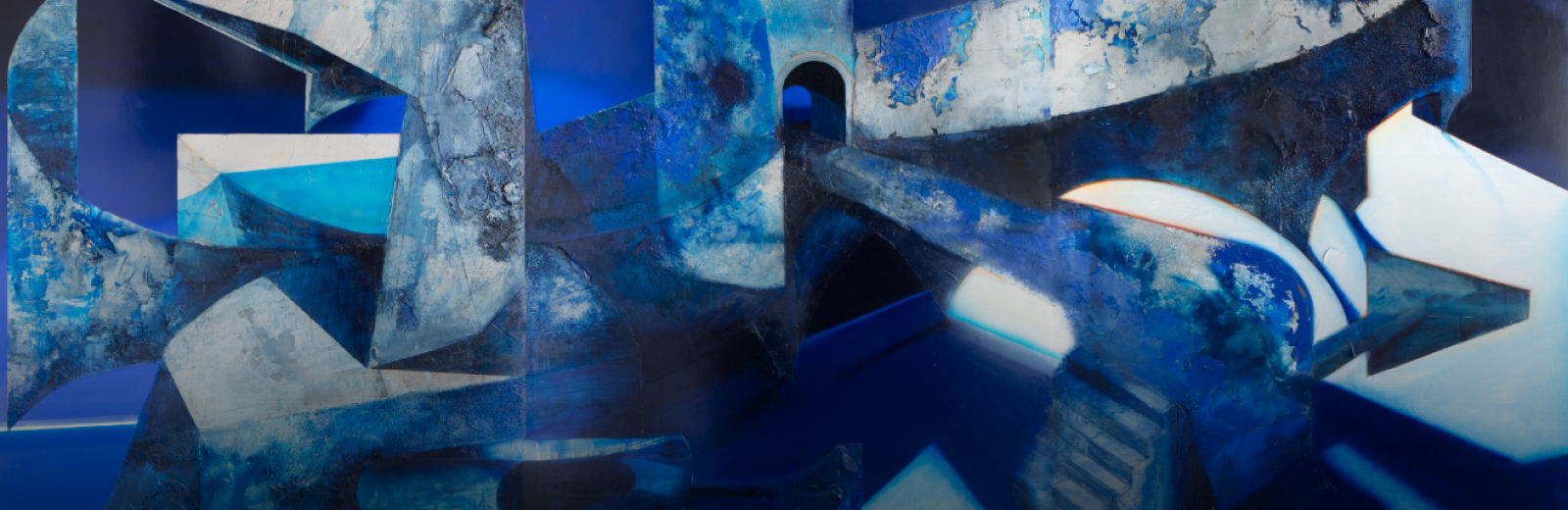
Erarta Museum of Contemporary Art presented an exhibition by the Mexican artist Néstor Jiménez whose paintings turn urban environments into animate beings and witnesses of historical events
-
Visions of city outskirts in which material residues of past ideologies coexist with dreams of a better future
-
A dialogue with the legacy of Mexican muralism and a tribute to neo-brutalist architecture executed in evocative shades of blue
-
Concrete, reclaimed wood, and construction debris as the physical and symbolical framework of paintings
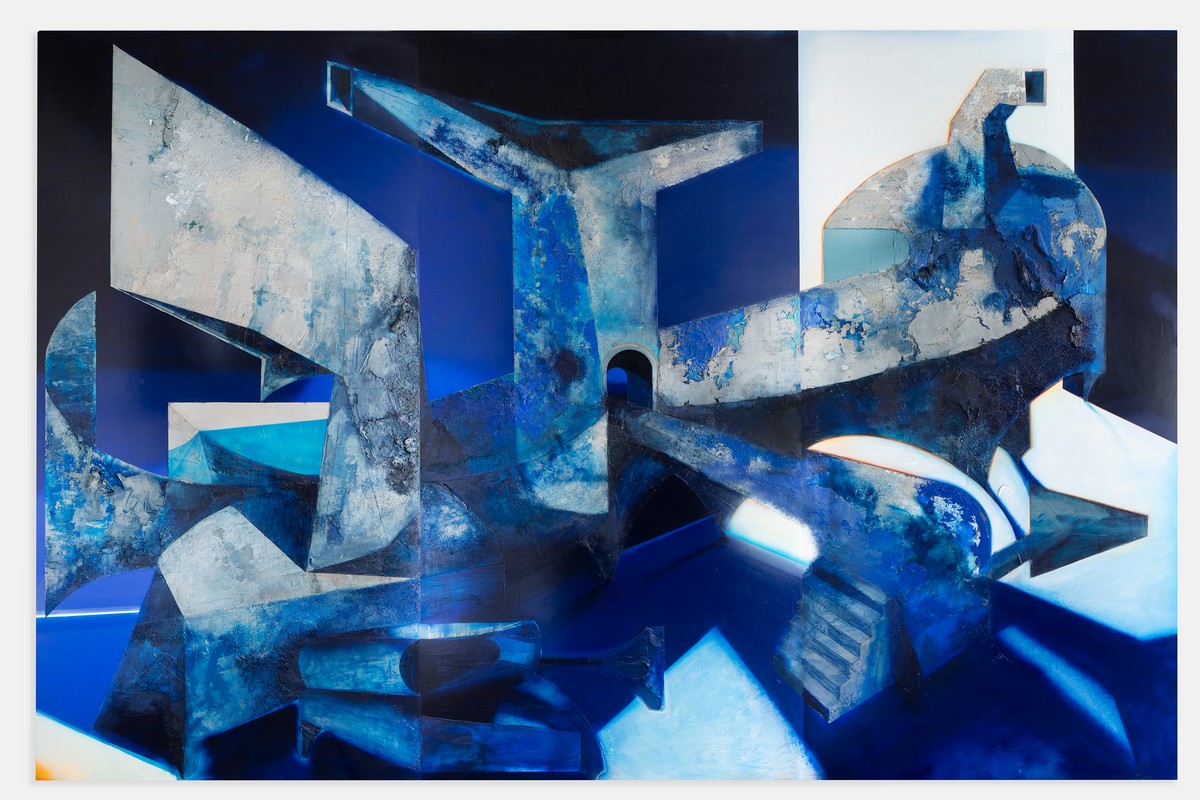
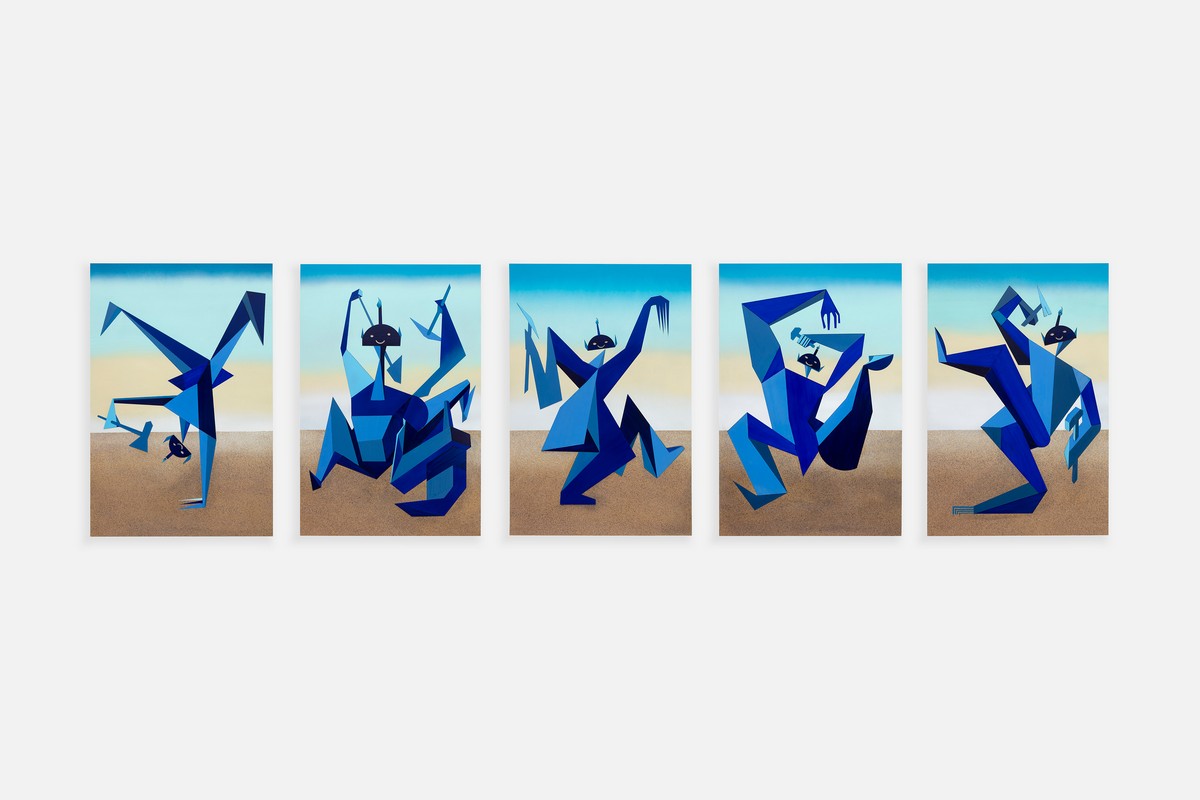
In the work of Néstor Jiménez, the city is not merely a backdrop, but a living entity – an organism whose surfaces absorb political struggle, collective memory, and the material residues of ideology. Across painting, installation, video, and collage, Jiménez approaches the urban landscape as both archive and actor: a terrain in which histories of labour, housing, and political aspiration are inscribed into concrete, pigment, and reclaimed materials.
His practice is object-based yet, conceptually driven. As the artist explains, ‘I conceive of my painting as the result of a conceptual exercise – one that emerges from complex social phenomena. It contains a series of meanings. The existence of the object is important.’ In Jiménez’s work, matter itself becomes historical evidence. Concrete, salvaged wood, and construction debris – materials drawn from everyday housing on the outskirts of Mexico City – form the literal support for some of his paintings. These substances carry with them the ideological and social ambitions embedded in the architecture of the twentieth century: dreams of modernization, collective housing, and political transformation.
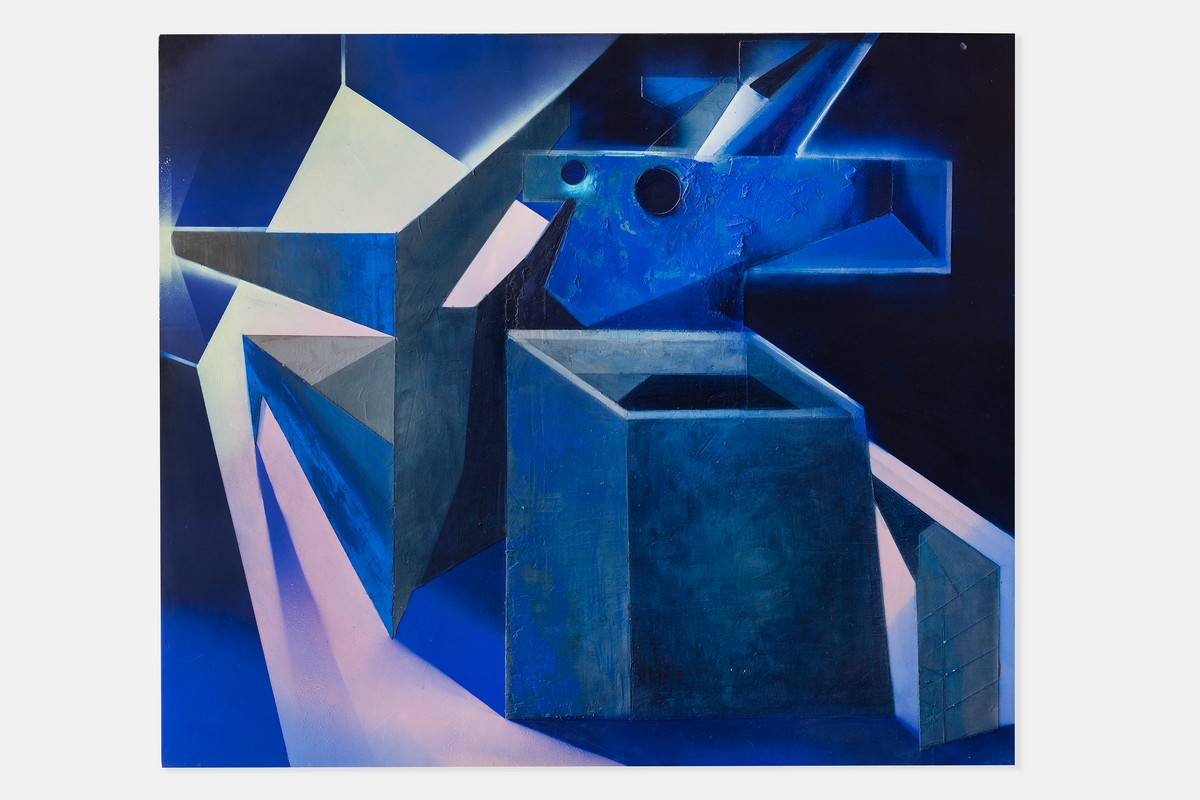
The formal language of Jiménez’s work often recalls the angular dynamism of Mexican muralism, particularly the polyangular spatial strategies developed by David Alfaro Siqueiros. Neo-brutalist architectural forms dominate his compositions, rendered in a restrained palette of blue ochres as shown in this exhibition. Buildings appear anthropomorphic, as if endowed with bodily presence. Walls bend, towers lean, and facades become figures – suggesting a city that observes, remembers, and responds. In these images the urban landscape becomes sentient: a witness to political history and social contradiction.
This dialogue with muralism is not purely aesthetic. Mexican muralism emerged in the aftermath of the Mexican Revolution as a state-supported project intended to reshape public understanding of the nation’s past and future. Monumental murals transformed public architecture into sites of historical narration and political pedagogy. Jiménez revisits this legacy critically. While the muralists sought to construct a unified national narrative, his work probes the fractures within collective memory – particularly those linked to leftist social movements that emerged in the eastern periphery of Mexico City during the late twentieth century.
In his Las celebratorias de Victor Sotelo (Kobolt. Version 1) series the character which is manifested from the various elements of architectural detritus becomes animated, but at the same time is wrested from the very material conditions that produced him. Seemingly entertained and entertaining, this performative levity is undercut by a latent menace. The tools he carries are no longer neutral instruments of labour; in his grasp, they are transfigured into emblems of power. The hammer, in particular, ceases to function as a utilitarian object and instead operates symbolically, evoking the ideological weight of socialism and its historical entanglements with labour, struggle, and control.
Ultimately, Jiménez treats the urban landscape as both canvas and subject: ‘The idea is to give the works a symbolic dimension in terms of their materiality; that is, for me, each material represents something in its historical condition and, of course, a social and class practice.’ Through distorted architectures, reclaimed materials, and references to the muralist tradition, he constructs a visual language in which the city itself appears to think, remember, and testify. His works do not simply depict political history; they materialize it – revealing the built environment as a repository of collective memory and unresolved ideological tension.
The exhibition is curated by Dasha Vass
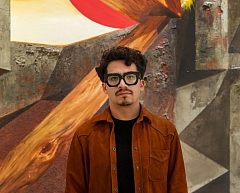
A graduate of the National School of Painting, Sculpture and Engraving La Esmeralda, Néstor Jiménez was born in 1988 and has exhibited extensively in both solo and group presentations across Mexico and internationally. His work has been shown at key institutions in Mexico City, including El preludio de la ruptura (Centro Cultural Border), El ejercicio de las buenas voluntades (Nixon Gallery), Parasitage, ruidos negros and Pintura reactiva (Carrillo Gil Art Museum), TROMBA (University Museum of Contemporary Art – MUAC), Anverso (University Museum of Sciences and Art – MUCA Roma), La importancia de ser autosuficiente (Proyectos Monclova), and México bárbaro (Siqueiros Public Art Gallery), among others.
Internationally, Jiménez has presented work in No sé qué es una casa (Galería La Fugitiva, Havana, Cuba), Temps fugaç / Temps aprecari (VADB, Barcelona, Spain), and Juannio 2018 (Guatemala City, Guatemala), and has participated in the 14th Havana Biennial (2021–22) and the 16th Lyon Biennial (2022–23). His practice has been supported by numerous grants, including the BBVA Bancomer – MACG Programme, FONCA Young Creators Grant (2011, 2015, 2020), the Program for the Promotion of Artistic Creation and Development (PEDCA, 2018), and the Adidas Border Grant (2016). He is a member of Mexico’s National System of Art Creators.